How to manage multiple medicines on one schedule
Make one list from the packs, keep the times already on the labels, and ask a pharmacist before you combine them into a box.
Make a complete list
Put every product on one page before you change anything: prescribed medicines, pharmacy and supermarket products, vitamins, supplements, and herbal products.
For each one, copy from the pack:
- Name and strength.
- How much, and at what times.
- Any note about food or a gap before eating.
- Who prescribed it, if anyone did, and what you were told it is for.
- The start date, and a stop date if there is one.
Check the list against the packs and keep it somewhere you and anyone helping can find it.
Return stopped or expired medicines to a pharmacy. See how to dispose of expired medicines.
If you help a parent, see keeping track of a parent's medicines.
Organise the schedule you were prescribed
Group doses by morning, midday, evening or bedtime where that matches the labels. Ask your pharmacist before changing a time.
- Write the time once, then the medicines due then.
- Include any instructions about food or spacing doses.
- Leave when-needed medicines off the timed rows.
- Use one record to mark each dose when you take it.
Set reminders for those times. Remembering a daily medicine has suggestions for daily reminders.
What with food, before food, and an empty stomach mean is in take with food or on an empty stomach.
If instructions seem to conflict, ask your pharmacist how to space the medicines.
Iron and a calcium tablet are a common pair. The best time to take vitamins explains more about spacing supplements.
Watch for the same ingredient twice
Two pain or flu medicines with different names can both contain paracetamol. Taking both is a double dose of that ingredient.
If you have already taken both, see what to do if you accidentally took your medicine twice.
The chance of an accidental overdose is higher when you take more medicines.
Look for:
- Two products for pain, cold, or sleep.
- A prescription and a pharmacy product for the same symptom.
- A new specialist medicine and an older one nobody has stopped.
Take the boxes, not just the list. Do not stop a prescribed medicine because it seems to duplicate another.
A liquid measured without its own syringe or spoon is an easy way to take the wrong amount. Keep that device with the bottle.
Ask about pill organisers
Once tablets leave their labelled blisters, a wrong strength is hard to see. Ask your pharmacist before you repack anything.
They may suggest an organiser, or make a pharmacy pack (a blister pack or Webster pack) grouped by day and time. Ask which of yours can go in.
Choosing the compartments and filling a week is in how to use a pill organiser.
A when-needed medicine does not suit a compartment that assumes every day is the same. A pharmacy may charge to fill a blister pack, so ask what applies to you.
Until a pharmacist says a box you fill yourself is suitable, leave the medicines in their packs. If one is already filled and you are not sure, take it and the leftover packs in, and do not guess which tablet is which.
See how to store medicines for advice on where to keep the packs, including on hot days.
Ask for a review when the list is hard to follow
Ask about a Home Medicines Review when doses are missed, a medicine is new, or your medicines changed after a hospital stay. A credentialed pharmacist visits, reviews what you actually take, and the doctor talks through a Medication Management Plan.
The review itself is free. The referral visit can cost unless the doctor bulk bills.
Tell them which doses you skip, and why. Skipping because a medicine upsets you is a reason to change the plan with the prescriber.
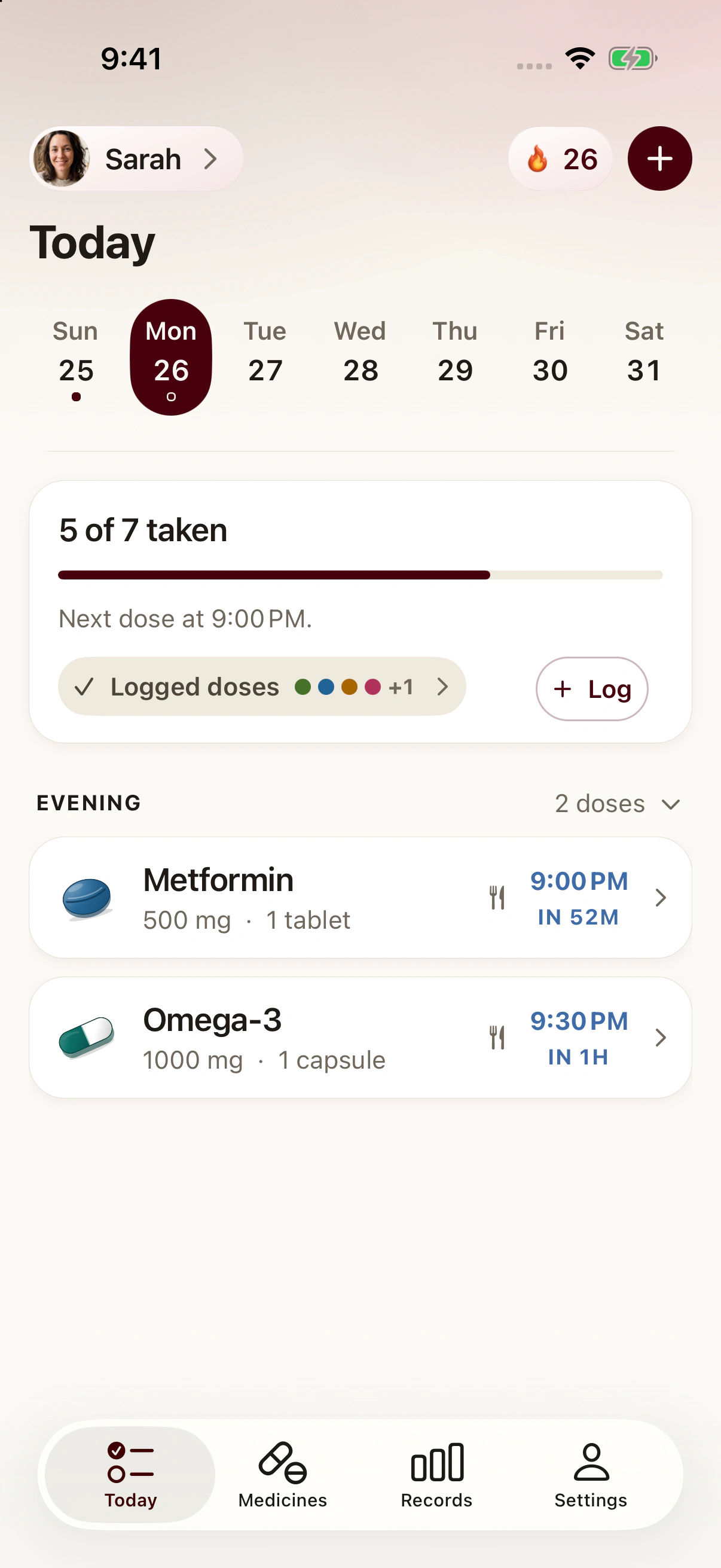
Pillbo can show your scheduled doses and what you logged as taken or skipped. It does not check for medicine interactions.
If a dose was missed, follow what to do if you miss a dose.
Review your record
Spend a minute at the same quiet time, often the evening. Look at the row you just finished.
- Each timed medicine is marked taken or deliberately skipped.
- When-needed doses are written down too.
- Note any medicine that is running low.
- If a pack is already empty, see what to do when you have run out of medicine.
If a dose is unrecorded and you are unsure whether you took it, ask a pharmacist or doctor for advice before taking more.
Common questions
How do I organise a schedule with several medicines?
Make one list from the labels, group the day by the times you were already given, and mark each dose when you take it.
Can I put all my tablets in a weekly pill organiser?
Ask your pharmacist first. Some medicines are damaged out of their pack, and a when-needed medicine does not suit a fixed compartment.
What if two medicines look like they do the same job?
Do not stop either of them on your own. Take both packs to a pharmacist or doctor.
Sources
- Accidental overdose of medicine, healthdirect
- Medicines safety for older people, healthdirect
- Home medicines review, healthdirect
- Getting the most out of your pharmacist, healthdirect