Take with food or on an empty stomach? What medicine labels mean
Take with food means during a meal or just after, and a small amount is usually enough. On an empty stomach means at least one hour before a meal, or two hours after, unless your label says otherwise.
Take with food or on an empty stomach
If you are checking the take on an empty stomach meaning, it is a gap around a meal, not a clock time you invent. Use the wording on your own pack, including when it says take with food instead.
For most medicines, food timing does not matter. When a label or leaflet does give a food line, follow it, because the wrong time can stop a medicine working properly or cause side effects.
Look for a line about food, or about taking the medicine between meals. A prescription label is written for you, so a general gap does not replace it.
Read that label with the Consumer Medicine Information (CMI) leaflet. The leaflet explains how to take that medicine, and you can ask your pharmacist for a copy if the box does not include one.
| The label says | What it means | When to take it |
|---|---|---|
| With food, or with or just after food | A small amount of food is usually enough | During that meal, or just after |
| On an empty stomach | At least one hour before a meal, or two hours after | Take it and eat an hour later, or wait two hours after you eat |
| Before food | Not with the meal. Use any time the label adds | That long before you eat. If no time is given, use the empty-stomach gap and check with a pharmacist |
| With or without food | Either is acceptable for this medicine | The same way each day, with meals or away from them |
| No food line | Food timing usually does not matter | Ask a pharmacist if you are unsure |
How long after eating is an empty stomach
On an empty stomach means a set time away from food: at least one hour before a meal, or two hours after, unless your label gives a different gap. Take the medicine and eat one hour later, or eat first and take it two hours later.
Before breakfast is the simple version of the first option, if you can wait an hour to eat. Two hours after dinner fits when the morning is already crowded.
Before food belongs with the empty-stomach instruction. If the label names the minutes or hours, count back from the meal by that amount, then eat.
If it only says before food, use the one-hour or two-hour gap, and ask a pharmacist to confirm it for your medicine.
Missing that gap once in a while is unlikely to do harm. Taking an empty-stomach medicine with food every day may mean it does not work as well.
If you are not sure the dose you just took still counts, ask a pharmacist before you take another.
Take with food or without food
With food, or with or just after food, a small amount of food is usually enough. Take it during the meal, or just after you finish.
Where the aim is to avoid an upset stomach, a biscuit or a sandwich is usually enough. Do not use milk, cheese, or yoghurt if the label warns you about calcium, because dairy can bind to some medicines and less of the dose is absorbed.
A food line is there for a reason:
- It can reduce nausea, vomiting, or stomach upset.
- Some medicines are absorbed properly only when you have eaten.
- Some are meant to work with that meal.
Antacids are usually best with food or soon after eating, and the effect may last longer then. Leave two to four hours between an antacid and your other medicines, and still follow the packet.
With or without food means either way is acceptable. Take it at the same point relative to meals each day.
Do not copy the food line from a different box. Some antibiotics are taken with food and others on an empty stomach, which how to take antibiotics explains.
Supplements follow their own food rules. See the best time to take vitamins.
Swallow the dose with water unless the label names another drink. Water does not interact with medicines, and enough liquid helps the dose reach your stomach.
Some medicines need a large glass of water, because a tablet that sticks in the food pipe can irritate it. The label is where that warning sits.
For a child, ask a pharmacist before you mix a dose into food or a drink, and do not mix it into formula or breastmilk. See how to give medicine to a child.
Fit the dose around your day
- Copy the food line from the label and from the CMI, if the pack includes one.
- If neither mentions food, keep a time you can repeat, and ask a pharmacist if you are unsure.
- For with food, attach the dose to a meal you rarely skip.
- For an empty stomach, take it at least one hour before that meal, or two hours after it.
- For before food with a time on the label, set the dose that long before you eat, then eat.
- If one medicine needs an empty stomach and another needs food, keep two times, and do not move the first onto the meal.
- Swallow it with water, then mark the dose you actually took.
A morning with both rules can look like this, when both labels agree. Take the empty-stomach medicine when you wake, eat breakfast at least one hour later, and take the with-food medicine during that breakfast or just after.
If mornings will not work, take the empty-stomach medicine at least two hours after dinner. Ask a pharmacist first if a label names a different gap, or you cannot see how to separate the two times.
Several medicines on one list, each with its own food line, are easier to sort in how to manage multiple medicines.
Set a reminder for each of those times, and mark the dose after you swallow it, not when the alarm rings. How to remember to take your medicine covers that habit.
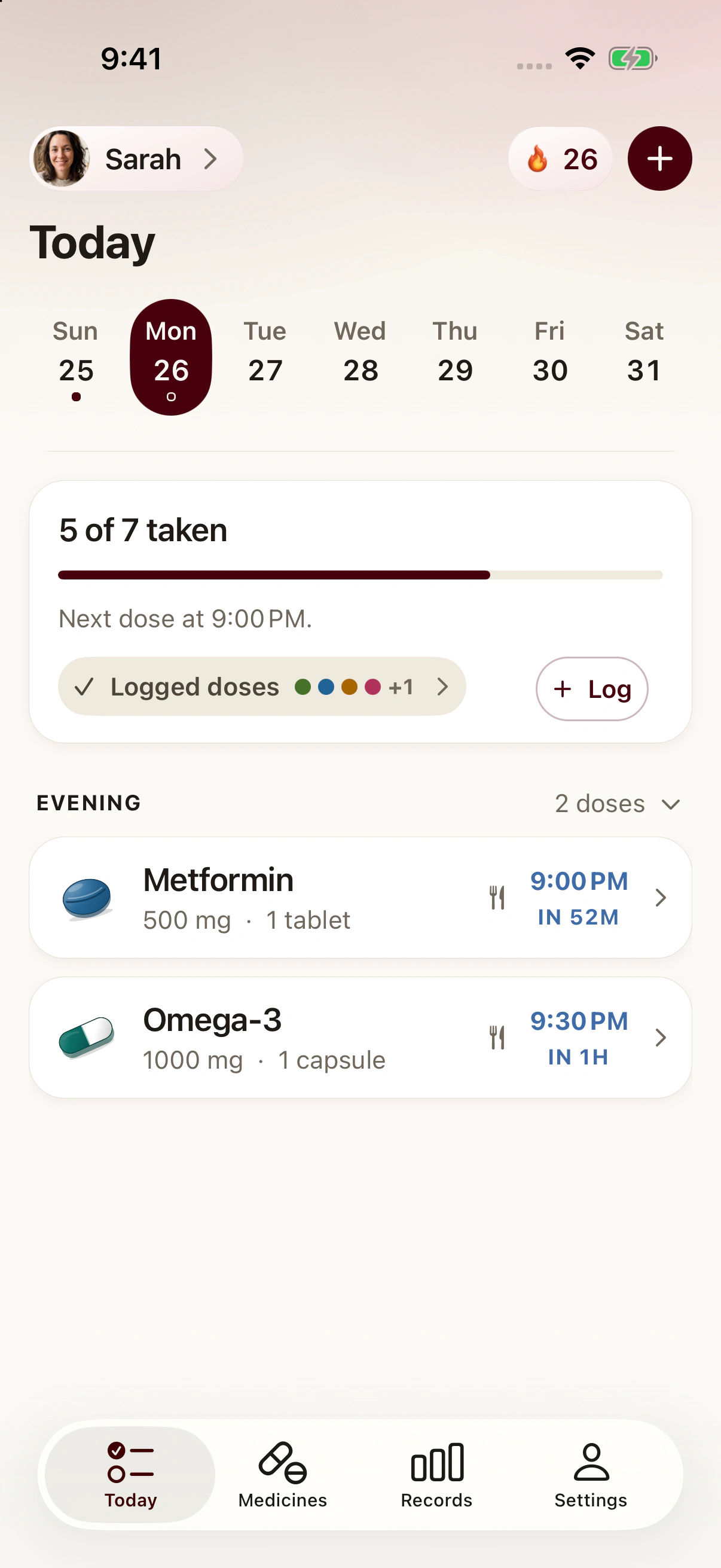
Pillbo can hold the empty-stomach reminder and the with-food reminder as two separate times, and a log of each dose you mark taken, skipped, or missed. It will not tell you which food rule a medicine needs.
When to ask before you move a dose
Ask a pharmacist or a doctor before you change a time if any of these are true.
- The label and the leaflet do not match.
- You want to move an empty-stomach dose onto a meal because it upsets your stomach.
- An antacid and another medicine would fall inside two to four hours of each other.
- The label tells you to avoid a food, a drink, or dairy.
- You took a dose the wrong way and you are not sure it still counts.
If you still cannot find a food line, you can speak to an NPS MedicineWise pharmacist on 1300 134 237. Ask before you take another dose to make up for one you took the wrong way.
Common questions
What does take on an empty stomach mean?
Take it at least one hour before a meal, or two hours after, unless your own label gives a different gap.
How long after eating is an empty stomach?
Wait two hours after a meal, or take the medicine first and eat one hour later.
Should I take medicine with food or without food?
Follow the food line on that pack or its leaflet, because a different medicine can have the opposite rule.
What does before food mean on a medicine label?
It means not with the meal. Use the time the label names, or the empty-stomach gap if it names none, and ask a pharmacist if you are unsure.
Sources
- Medicines and food, Healthify
- Side effects of medicines, healthdirect
- How to read Consumer Medicine Information (CMI), healthdirect
- What's on my medicine label?, Therapeutic Goods Administration
- Medicines: tips for carers, NHS
- Antibiotics - Interactions, NHS
- Antacids, NHS