How to give medicine to a child safely
Use the amount on the label for your child's weight, measured with the syringe or cup from the pack, not a kitchen spoon. Write down the name, time and amount so the next person does not give it again.
Check the label and your child's weight
The right amount depends on your child's weight and age, as the label sets out. Children's medicines often come in different strengths for different ages, so read the pack in your hand.
| On the label | What to do |
|---|---|
| Weight or age band | Use the row that matches your child now |
| Strength | The same name can come in more than one strength |
| Active ingredient | Do not give two products that both contain it |
| "As directed", or no amount | Ask a pharmacist, doctor, or child health nurse before you measure |
| Expiry | Do not give a medicine past the date on the pack |
A pain medicine and a cold medicine can both contain paracetamol, under different names. Check the active ingredient on every pack, including pharmacy and supermarket ones.
Do not give more than the label recommends. If more than one child takes medicines, match the name on the pack to this child.
Measure with the syringe, not a spoon
Use the oral syringe or measuring cup that came with the bottle. Kitchen spoons hold different amounts, so they are the wrong tool.
If the pack has no syringe or cup, ask a pharmacist for one. Keep that device with the bottle, away from the cutlery.
| The label says | Before you measure |
|---|---|
| Suspension | Shake the bottle so the medicine is mixed through the liquid |
| Solution | Leave it. The medicine has already dissolved |
| It does not say which | Ask the pharmacist |
- Wash your hands, then read this bottle's label.
- Shake it when the label says suspension.
- Draw up or pour the amount on the label, then read the number again, including the decimal point.
- Give the whole dose, and stay until your child has swallowed it.
- Put the child-resistant lid straight back on, and remove a bottle adapter first, because the adapter is not child-proof.
- Wash and dry the syringe, and keep it with that bottle.
If your child spits some out, ask a pharmacist before you measure any more. Do not guess a top-up.
Ask a pharmacist before you crush a tablet or open a capsule.
Ask before you mix it into food
Check with a pharmacist before you mix a dose into food or a drink. Some medicines need an empty stomach, and some should not be taken with milk or yoghurt.
What those words on a label mean is in take with food or on an empty stomach.
If mixing is suitable, your child has to finish all of that food or drink. Anything left is part of the dose they did not get.
Do not mix a dose into formula or breastmilk. Your child may not finish the feed, and the changed taste can put them off feeding.
Keep one record when more than one person gives it
Write the dose down before you leave the room. The next person needs to see that it was already given.
- Medicine name and active ingredient.
- Time, and the amount you actually gave.
- Who gave it.
Keep that note with the medicines. A fridge chart works when every carer uses the same one.
Check the record before you measure the next dose. If it is blank and you did not see the dose given, do not give another until you have asked.
If you still cannot tell, call a pharmacist before anyone gives more. The same caution for a dose you are unsure about is in what to do if you miss a dose.
Leave a babysitter, grandparent, or educator this briefing:
- The name, the amount, the times, and where the syringe is.
- The record, and that they write the dose down before they walk away.
- To call you or a pharmacist if your child spits some out, and not to measure a second amount.
- The Poisons Information Centre on 13 11 26, and 000 in an emergency.
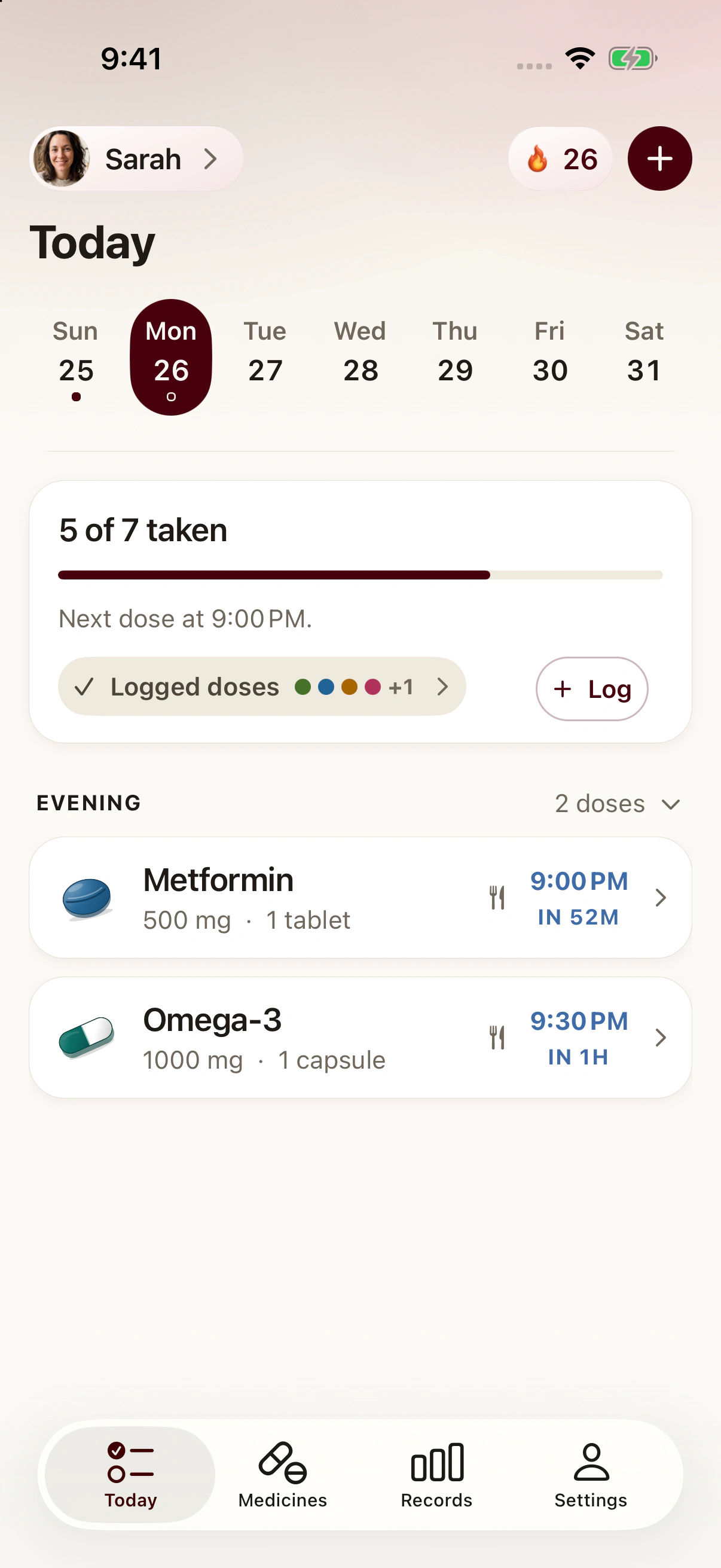
A paper chart is enough when everyone writes on it. Pillbo can hold the times from the label, and a log of each dose marked taken, skipped, or missed.
A separate profile for your child is part of Pillbo Pro. You can invite another carer to that profile and choose whether they can log a dose.
Accepting a shared profile is free and needs an account. Updates from another phone need an internet connection.
If a dose runs late, its late-dose alarm can ring even on Silent, on iPhone and Android. It will not tell you the right amount, and a dose nobody marked still has to be checked before anyone gives another.
Store medicines out of reach
Medicines are the most common cause of poisoning in young children. Keep them out of sight and reach, in the original pack, inside a locked cupboard.
- Use a cupboard at least 1.5 m high if you can, with a child-resistant lock.
- Close the lid and put the bottle back as soon as the dose is given. A child-resistant lid is not child-proof.
- Keep a fridge medicine in a lockable container, and only refrigerate it when the label says so.
- Keep handbags, and visitors' bags, out of reach. Bags often hold medicines.
- Call each medicine by its name. Do not call it a lolly.
Heat, the bathroom, and where a fridge medicine should sit are in how to store medicines safely at home.
If too much was given
If your child has difficulty breathing, will not wake, is having a seizure, or has collapsed, call 000 for an ambulance.
Call the Poisons Information Centre on 13 11 26 if you think you gave too much, gave the wrong medicine, or gave the same dose twice. Call straight away, even if your child looks well.
What to have ready on that call is in what to do if you accidentally took your medicine twice.
Do not treat it until they tell you what to do. Have the pack and the dose record with you when you call.
Outside Australia, use the local emergency number and the local poisons service.
Common questions
Can I use a kitchen spoon for my child's medicine?
No. Spoons hold different amounts. Use the oral syringe or measuring cup from the pack, or ask a pharmacist for one.
Can I mix my child's medicine into formula or milk?
Do not mix it into formula or breastmilk. Ask a pharmacist before you mix a dose into any other food or drink.
How do I stop two carers giving the same dose?
Keep one record of the name, time and amount, and check it before anyone measures the next dose.
Who do I call if I gave my child too much medicine?
If they are very unwell, call 000. Otherwise call the Poisons Information Centre on 13 11 26, and do not wait for symptoms.
Sources
- Medicines for babies and children, healthdirect
- How to give your child medicine, The Royal Children's Hospital
- Medicines that can poison children, Raising Children Network