Schengen certificate for medication
The Schengen certificate for medication is issued by a Schengen state to its own resident, for a prescribed narcotic or psychotropic medicine, for up to 30 days. From Australia, carry a prescription and a doctor's letter, and check each country you enter.
Who the certificate is for
The Schengen certificate for medication is the Article 75 certificate. A Schengen state issues it to someone who lives there and is travelling to another Schengen state with a prescribed narcotic or psychotropic medicine.
It lasts up to 30 days. You need a separate certificate for each of those medicines.
The prescriber fills it in. A competent authority in that home country then authenticates it, from the prescription, before the trip.
Ask your doctor or pharmacist whether any medicine you take is treated as narcotic or psychotropic where you are going. Commonly restricted medicines include:
- Amphetamine medicines, such as ADHD medicines.
- Medicinal cannabis.
- Opioid painkillers, such as codeine.
- Cold or flu tablets that contain pseudoephedrine.
- Sleeping pills.
- Anti-anxiety medicines and antidepressants.
That list is a prompt for the question, not a verdict on your pack. Packing for the rest of the trip is in travelling with medication overseas.
Which countries are in the Schengen Area
The certificate is for travel between these states:
- Austria, Belgium, Bulgaria, Croatia, Czech Republic, Denmark, Estonia, Finland, France and Germany.
- Greece, Hungary, Iceland, Italy, Latvia, Liechtenstein, Lithuania, Luxembourg, Malta and the Netherlands.
- Norway, Poland, Portugal, Romania, Slovakia, Slovenia, Spain, Sweden and Switzerland.
Australia is outside this list, and so are the United Kingdom and Ireland. Check the list again before you travel, because membership can change, and it is not the same as the European Union.
Schengen resident or travelling from Australia
| Rule | A Schengen resident | Travelling from Australia |
|---|---|---|
| Who it is for | Someone who lives in a Schengen state and is travelling to another | A visitor from outside the Schengen Area |
| Article 75 certificate | The home state can issue it | Australia cannot issue it |
| How long | Up to 30 days, with one certificate for each controlled medicine | The prescription and a doctor's letter, for the trip you name |
| Quantity | The period on the certificate | The limit set by each country you enter |
| Authentication | The home country's competent authority, before you travel | Ask the embassy whether the letter needs a stamp at home |
Ask for a doctor's letter
Carry the prescription as well as the letter. Ask for these details, then check them against the country you are entering.
| Put this on the letter | What to write |
|---|---|
| The medicine | The name on the pack you are carrying |
| The active ingredient | The international name, because brand names differ |
| The dose | The individual dose and the daily dose |
| The trip | How long you will be away |
| Personal use | That it was prescribed for you, or for the person travelling with you |
Ask if the prescription or letter needs a translation into the local language. English is accepted in some countries and not in others.
A medicines list is not this certificate. It is what you hand the doctor so the letter matches the packs. How to keep a medicines list keeps that page current.
What a visitor needs in four countries
These are examples. Read the country page, then confirm it with the embassy, because a visitor's rule can differ from a resident's rule.
Many countries allow no more than a 30 to 90 day supply of a prescription. A controlled medicine can have a tighter limit, and the limit can depend on where you are travelling from.
| Entering | What to arrange before you fly |
|---|---|
| Germany | For a narcotic medicine, a multilingual certificate naming the individual and daily doses, the active ingredient and the length of the trip, authenticated by a health authority in your home country. Ordinary medicines are separate: up to 3 months' personal supply. |
| Belgium | For a narcotic or psychotropic medicine, a valid prescription or a certificate validated by a government, and no more than 3 months of treatment. Do not have these medicines posted to you. |
| The Netherlands | Proof the medicine is for your own use, and an official certificate if it is an Opium Act medicine. Ask whether that certificate must be legalised. |
| Switzerland | A form for travellers from outside the Schengen Area, completed by your doctor, or the form Switzerland publishes if your home country does not issue one. Narcotic medicines are limited to 30 days of treatment. |
Check the country, then the embassy
- Open the country regulations list and read the page for every country you enter, including transit.
- Ask the embassy or consulate what they accept from Australia, including a stamp from a health authority at home.
- If the medicine is not allowed, ask your doctor about an alternative before you fly.
- Carry only the quantity that country allows for a visitor.
The list does not cover every country. Where a page is missing, the embassy is the check.
Keep the original pack
Leave each medicine in its original packaging, with the dispensing label intact. Officials use the pack to see that it is a medicine.
PBS medicines, and the flight home
You can take PBS medicines for your own use, or for someone travelling with you. Taking or sending them for anyone else is illegal.
Take the doctor's letter, listing each medicine with the strength and the daily dose. If you cannot get the letter, fill in a Medicine Export Declaration and take that through customs.
Leave the medicine in its original packaging. Call 1800 500 147 if you need to check the amount.
On the way home, bring no more than a 3-month supply, in your accompanied baggage. Declare the medicine to the Australian Border Force.
Carry a letter or a copy of the prescription, in English, showing the medicine was prescribed for a medical condition. The exemption covers you, or an immediate family member travelling with you.
Do not bring medicine for anyone else, and do not sell or supply it. Some substances sit outside the exemption and need written permission from the Office of Drug Control.
The exemption can cover prescription medicines such as morphine, oxycodone, methadone, methylphenidate and benzodiazepines, when you meet those rules.
Dose times after you land
Write the dose times down before the clocks change. How to take your medicines across time zones is the plan to follow until your own doctor or pharmacist gives you a different one.
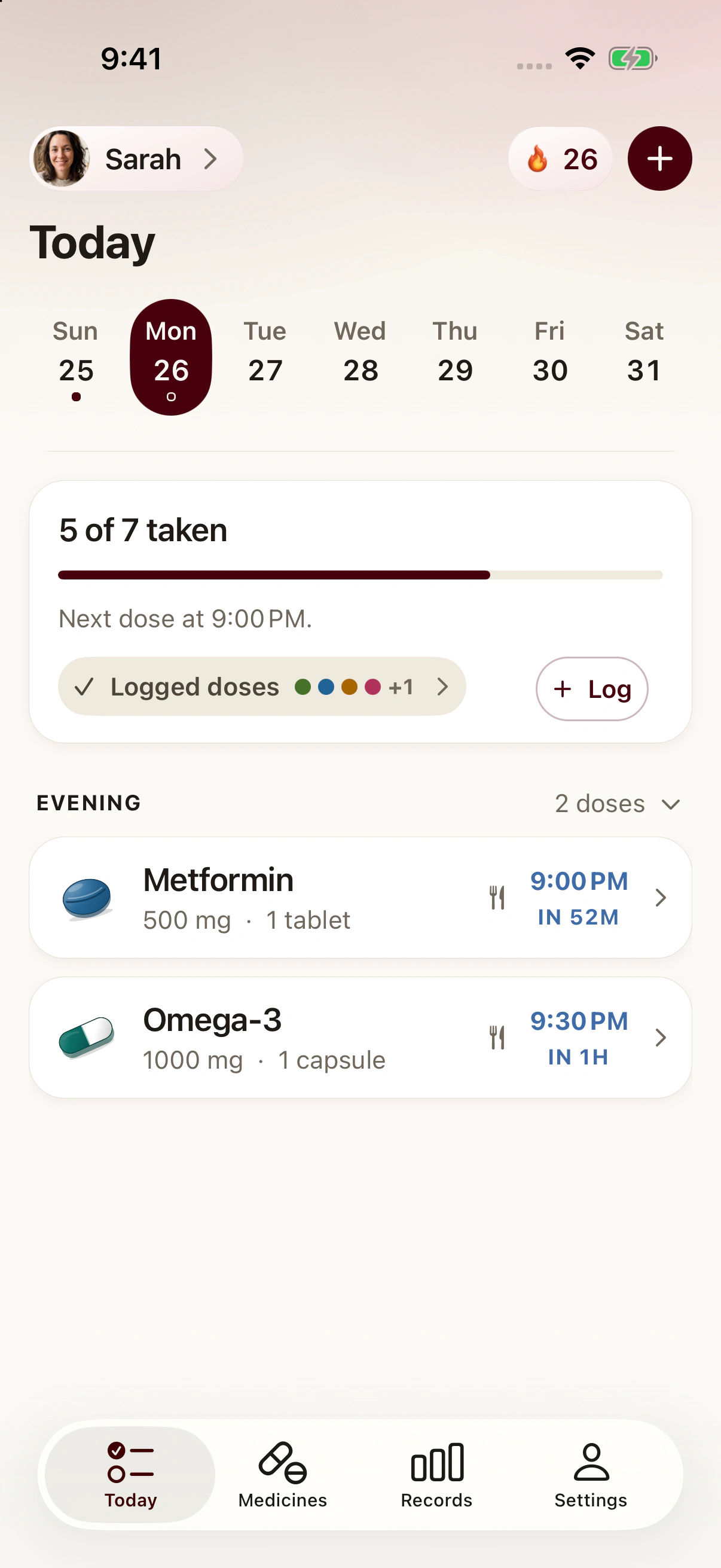
Pillbo can hold the medicines list you show the doctor, the dose times on the labels, and a log of what you took after a long flight. Your own reminders and dose logging are free, with no account needed.
Its late-dose alarm can ring even on Silent, on iPhone and Android. It will not tell you whether a medicine is allowed in another country, or whether a late dose should still be taken.
It is on iPhone now, and Android is coming soon.
Checklist
- Prescription and doctor's letter for each controlled medicine.
- Letter names the medicine, the international active ingredient, the individual and daily dose, and the length of the trip.
- Embassy check done for the destination and every transit country.
- Original packs, dispensing labels intact.
- Quantity inside that country's limit for a visitor.
- PBS letter or Medicine Export Declaration, for your own use or someone travelling with you.
- On the way home, no more than a 3-month supply, declared, with an English letter or prescription.
- A written plan for dose times after a time-zone change.
Common questions
What is a Schengen certificate for medication?
It is the Article 75 certificate a Schengen state issues to its own resident, for a prescribed narcotic or psychotropic medicine, valid for up to 30 days.
Can I get a Schengen certificate in Australia?
No. Only a Schengen state issues it, and only to a resident of that state.
What should I carry from Australia instead?
Your prescription and a doctor's letter with the medicine, the international active ingredient, the individual and daily dose, and the length of the trip.
How long does a Schengen certificate last?
Up to 30 days, with a separate certificate for each controlled medicine.
Sources
- General information for travellers carrying medicines containing controlled substances, International Narcotics Control Board
- Country regulations for travellers, International Narcotics Control Board
- Travelling with controlled drugs, Federal Institute for Drugs and Medical Devices
- Taking medication abroad, Austrian Federal Ministry of Labour, Social Affairs, Health, Care and Consumer Protection
- Schengen area, Swissmedic
- Travelling with narcotic-containing medicines, Swissmedic
- Medicinal products and narcotics, German Customs
- Information for travellers, Federal Agency for Medicines and Health Products
- Can I take my medication abroad?, Government of the Netherlands
- Taking medicine and medical devices overseas, Smartraveller
- How to manage your PBS medicine overseas, Services Australia
- Entering Australia, Therapeutic Goods Administration
- What medicines and substances can you bring in?, Australian Border Force