Travelling with medication overseas from Australia
Keep prescription medicines in the original labelled pack with a doctor's letter, and check they are allowed where you land and in transit. Take enough for the trip plus delays, for your own use, and bring no more than 3 months' supply back into Australia.
Before you leave
See a doctor or a travel clinic at least eight weeks before you go. Use the visit for the medicines you already take, and for enough supply to cover the trip.
- Ask for a letter that covers every prescription medicine, and any complementary medicine you are carrying.
- Check the medicine is allowed in every country you will enter, including transit, and whether you need a permit.
- Arrange enough for the whole trip, plus extra for delays, inside the legal limit.
- Read the insurance for lost medicine, a pre-existing condition, and care overseas.
- Pack the doses you need on the flight in carry-on, still in the original packs.
When the clocks change, follow a written timing plan. How to set those dose times is in how to take your medicines across time zones.
Ask for a doctor's letter
Authorities overseas may ask you to prove the medicine is yours. Carry the letter with your prescriptions.
| Include | What to write |
|---|---|
| Name of each medicine | The name on the pack you are carrying |
| Strength and daily dose | How much you take |
| How much you are carrying | The amount that matches this trip |
| Personal use | That it was prescribed for you, or for the person travelling with you |
| Complementary medicines | Vitamins and traditional medicines you are also carrying |
The name on the dispensing label must match the name on your boarding pass.
Keep the original pack
Leave each medicine in its original packaging, with the dispensing label intact, so it can be identified. Keep that pack with the letter.
Check every country on the route
Check the rules before you take a medicine out of Australia. Include countries you only pass through.
Some medicines that are ordinary here are restricted elsewhere. Commonly restricted medicines include:
- Amphetamine medicines, such as ADHD medicines.
- Medicinal cannabis.
- Opioid painkillers, such as codeine.
- Cold or flu tablets that contain pseudoephedrine.
- Sleeping pills.
- Anti-anxiety medicines and antidepressants.
Also take care with strong painkillers from a pain specialist or a hospital, other prescribed medicines of addiction, and controlled drugs. Ask your doctor or pharmacist which of yours are in that group.
Contact the embassy or consulate, and read the health section of that country's travel advice. If the medicine is not allowed, ask your doctor about an alternative before you fly.
You may need a permit. Penalties for carrying or using controlled drugs can be severe.
PBS medicines are for personal use
You can take PBS medicines for your own use, or for someone travelling with you. Taking or sending them for anyone else, including a relative who is not on the trip, is illegal.
If you cannot get the doctor's letter for a PBS medicine, fill in a Medicine Export Declaration and take it through customs.
Take only enough to cover the trip. The amount depends on PBS rules, your prescriber, Australian export law, and the import rules of the other country.
Call 1800 500 147 if you need to check the amount. The line is open every day, at any hour.
Once you have left, no further PBS supply can be dispensed or sent to you. That includes a supply that was dispensed before you flew.
If you run out, see a local doctor and take the original pack so they can see the dose and strength. Medicine bought overseas is not a PBS cost and cannot be refunded as one.
Check the strength with a doctor or pharmacist there. The ingredients can differ from the Australian pack.
When you are home, start with what to do if you have run out of medicine.
Take enough, plus extra
Count the days you will be away, then add a little for delays. That extra is part of covering the trip, and it still has to sit inside the PBS limit and each country's import rules.
A large amount can look like you plan to sell it. If the trip is long, confirm the quantity is still within the law before you add extra.
Carry-on and checked luggage
Keep the supply you need for the flight in the cabin. Do not put the whole trip in one bag, in case that bag is lost or stolen.
| Pack this | Where it goes |
|---|---|
| Doses for the flight, plus extra for delays | Carry-on, in the original pack |
| A spare amount | A separate bag, so one loss is not the whole supply |
| The rest of a longer supply | Checked baggage, still in the original pack |
| Liquid medicines | Carry-on. Medicines are exempt from the 100 mL limit |
| Needles or syringes needed on the flight | Carry-on, with the medicine and a doctor's letter or medical certificate |
Hypodermic needles are prohibited unless you medically need them. Show the letter at screening, and tell cabin crew when you board.
Empty syringes belong in carry-on only when that medicine is with them. Put needles you will not need on the flight in checked baggage.
If a medicine has to stay cool, ask the pharmacist before you fly and keep that supply with you. Where to keep medicines at home, including in the fridge, is in how to store medicines.
Check the insurance
Get travel insurance before you go. A reciprocal health care agreement can cover essential care and still not cover the medicine.
| Check | What to look for |
|---|---|
| Prescription medicine | Most policies do not pay for it, including medicine in a lost or stolen bag, or a prescription in hospital |
| A device that is lost, damaged or stolen | Whether the policy replaces it |
| A pre-existing condition | Disclose it in writing, or a later claim can be refused |
| A local doctor, and medical evacuation | Whether both are included |
You may need a specialised policy if you want cover for prescription medicine. You still need travel insurance where a reciprocal agreement applies.
When you fly home
The traveller's exemption covers many medicines you bring into Australia, including on the way home. It is for you, or an immediate family member travelling with you, such as a child with a parent.
| Rule | Limit |
|---|---|
| How much | No more than a 3-month supply |
| Who it is for | You, or an immediate family member on the trip. Do not sell or supply it to anyone else |
| Packaging | The original pack, with the dispensing label if you have it |
| Papers | A prescription, or a doctor's letter that names the medicine and the dosage |
| At the border | Be ready to declare every medicine to the Australian Border Force |
The exemption can cover prescription medicines such as morphine, oxycodone, methadone, methylphenidate and benzodiazepines, if you meet those rules. Codeine of any strength still needs a prescription or a doctor's letter.
Some substances cannot be brought in at all. Check before you fly home with a medicine you bought overseas.
A long trip still comes home with no more than a 3-month supply. Ask your doctor before you leave how you will get further supplies, because a PBS medicine cannot be sent to you while you are away.
Keep a list you can show
Write the list from the packs before the appointment: name, strength, dose, and what you were told it is for. Take it to the doctor, and keep a copy with your travel documents.
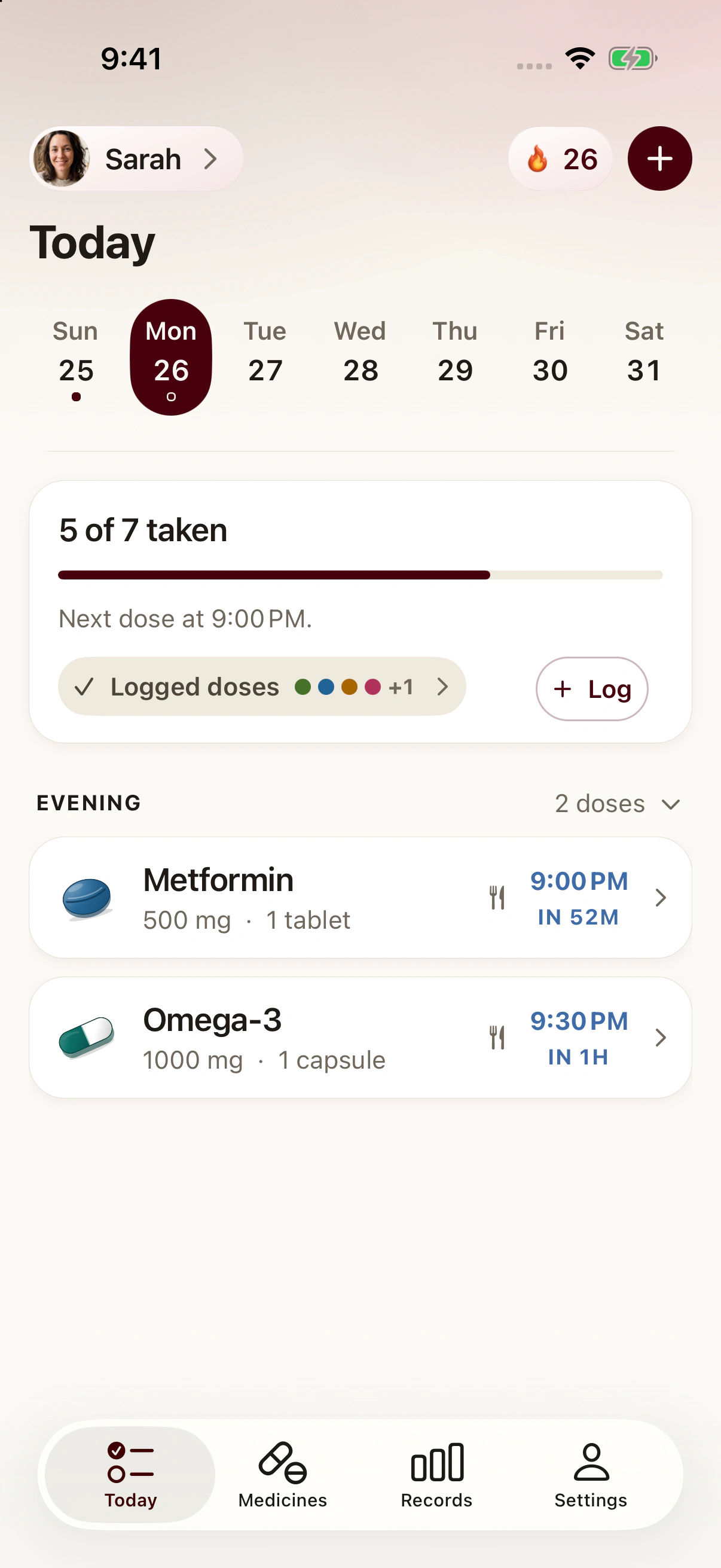
Count what is left, and book repeats in time to collect the supply before you fly. Pillbo can hold that list, reminders for the times already on the labels, and a flag when a pack is running low.
Its late-dose alarm can ring even on Silent, on iPhone and Android. It will not tell you whether a medicine is allowed in another country, or whether a late dose should still be taken.
Packing checklist
- Doctor's letter and prescriptions, kept with the medicines.
- Original packs, dispensing labels intact, name matching the boarding pass.
- Enough for the trip, plus extra for delays, inside the legal limit.
- Flight supply in carry-on, and a spare amount in a separate bag.
- Embassy or consulate check done for the destination and every transit country.
- Insurance read for lost medicine and any pre-existing condition.
- A written plan for dose times after a time-zone change.
Common questions
Can I take prescription medicine overseas from Australia?
Yes, for your own use or for someone travelling with you, if every country you enter allows it and you keep the original pack and a doctor's letter.
What should a doctor's letter include for travelling with medication?
The medicine name, the strength and daily dose, how much you are carrying, and that it is for personal use.
Should prescription medicine go in carry-on or checked luggage?
Put the flight supply, plus extra for delays, in carry-on, and keep a spare amount in a separate bag so one lost bag is not the whole supply.
How much medicine can I bring back into Australia?
Under the traveller's exemption, do not bring more than a 3-month supply, for you or an immediate family member travelling with you.
Sources
- Taking medicine and medical devices overseas, Smartraveller
- How to manage your PBS medicine overseas, Services Australia
- Running out of PBS medicines when overseas, Services Australia
- Travelling with medicines and medical devices, Therapeutic Goods Administration
- Entering Australia, Therapeutic Goods Administration
- Leaving Australia, Therapeutic Goods Administration
- Travelling to or from Australia with medicines and medical devices, Office of Drug Control
- Travel health advice, healthdirect