How to take your medicines across time zones
Ask your doctor or pharmacist for a written timing plan before you fly. Until they say otherwise, time the next dose from the last one you took.
Plan before you travel
See a doctor or a travel clinic at least eight weeks before you leave. Use the visit for medicines you already take, not only vaccines.
Bring the list from how to remember a daily medicine: name, strength, times, food notes, pharmacy medicines, and supplements. If a label says "as directed", ask for a time you can follow in an airport.
Check these before travelling:
- Is this medicine allowed in every country you will enter, including transit?
- Can you carry enough for the whole trip, plus delays, inside the legal limit?
Some medicines that are ordinary in Australia are restricted elsewhere. Common examples:
- Amphetamine medicines used for ADHD, and medicinal cannabis.
- Opioid painkillers such as codeine, and cold or flu tablets that contain pseudoephedrine.
- Sleeping pills, and anti-anxiety and antidepressant medicines.
Check the rules for every destination and transit country, particularly for controlled medicines.
Use that country's embassy or consulate, and the health section of its Smartraveller page. If the medicine is not allowed, ask your doctor about an alternative before you fly.
Time the next dose from the last one
Take the medicine according to the time since the last dose, unless your own doctor or pharmacist has given you a different plan. Local time of day is a question for them, medicine by medicine.
If you took a dose at 8am Australian Eastern time, a 24-hour schedule means the next dose is 24 hours later. That may be a different local time at your destination.
Write down the time of the last dose, and which clock that time belongs to. A long flight can change the date on your phone, so "Tuesday morning" can be two mornings, and a weekday on a pill box has the same problem.
- Some medicines are tied to a meal, to bedtime, or to morning where you are.
- A few days away can stay on Australian time, including meals and sleep, if your prescriber agrees the medicines can stay on that clock.
- A longer trip needs a written day for moving to local time. Move on that day.
Jet lag can follow a quick crossing of several time zones. It is often worse travelling east, and settling usually takes two or three days.
- Daylight, naps of no more than 30 minutes, and water help.
- Avoid alcohol and caffeine during the flight.
- Ask a doctor before using melatonin or a sleeping tablet. Sleeping tablets can become a habit.
- A sleeping tablet does not set the times for your other medicines.
Medicines where the gap matters
Tell them if you were ever warned not to take a dose late. Ask for written instructions for the journey and your stay.
Insulin and tablets for diabetes
| Situation | What to ask |
|---|---|
| Time difference under four hours | Whether you can keep the usual doses. An adjustment is not usually needed. |
| A longer trip east or west | The change for your insulin regimen. The GP or specialist sets it. Mention a short hop too. |
| Mealtime insulin, meal is late | Whether that dose waits until the meal is served. Confirm it for the insulin you use. |
| A low reading | What to carry: your glucose meter, and glucagon or a fast-acting carbohydrate. |
| Tablets that lower blood glucose | Whether to take them as prescribed, on local time. Check the plan for each medicine separately. |
The contraceptive pill
Regular dosing matters especially for the progestogen-only pill. Travelling west lengthens the gap since the last pill, and that can make it less effective.
A second watch, or a phone left on Australian time, shows the real gap. Keep that gap from stretching when you move to local time.
An implant or a vaginal ring does not move with the time zone. If this page and your leaflet disagree, follow the leaflet, or ask a pharmacist.
Put any other strict-interval medicine on the same list: a course you are midway through, a medicine for seizures, anything the leaflet treats as time-critical. If a dose is already late, use what to do if you miss a dose.
What to pack, under Australian rules
Hand luggage
- Medicines in the original pharmacy packaging.
- Enough for the trip, plus extra for delays, inside the legal limit.
- The doctor's letter with that supply.
- Ask your pharmacist how to carry a spare supply safely in case a bag is lost.
Other documents and checks
- Medicines are exempt from the 100 mL limit on liquids, aerosols, and gels.
- Carry the prescriptions as well as the letter.
- If you cannot get the letter, fill in a Medicine Export Declaration and take it through customs.
The letter should list
| Include | Why |
|---|---|
| Medicine name, plus the generic name | The brand on an Australian box may not be the name used overseas. |
| Strength and daily dose | Needed at the border, and for a doctor at the other end. |
| That it is for your personal use | Helps explain the supply at customs. |
| Complementary medicines, if you are carrying them | These may also be subject to entry restrictions. |
Leave a copy of that list at home with someone you can call.
PBS medicines
- You can take PBS medicines for your own use, or for someone travelling with you.
- Taking or sending them for anyone else, including a relative staying at home, is illegal.
- Take only enough for the trip. The amount depends on PBS rules, your prescriber, Australian export law, and the other country's import rules.
- Ask the pharmacist, or call 1800 500 147. It is open every day, at any hour.
- Many countries allow about 30 days and still want a prescription, checked with the embassy and separate from the PBS limit.
Once you have left, no further PBS amount can be dispensed or posted out to you. That includes a supply dispensed before you flew.
If you run out, see a local doctor and take the original pack. Medicine bought overseas is not a PBS cost and cannot be refunded as one.
A reciprocal health care agreement may cover essential care and still not cover the medicine. You still need travel insurance.
- Ask if a lost bag is covered when the medicine is inside it.
- Many policies will not pay for prescription medicine, including a prescription filled in hospital.
- You may need a policy that replaces a lost, damaged, or stolen medicine or device.
Heat, fridges, and buying more
- Extreme heat or cold can make many medicines less effective. Check whether yours needs a fridge, including at the hotel.
- Do not hand the only pack to cabin crew. Airlines are generally not set up to store a passenger's medicine, and a pack given to the crew can be lost.
- Insulin storage limits vary by product. Ask your pharmacist how to keep yours at the right temperature throughout the trip.
- A box bought overseas can be poor quality or counterfeit, and the strength or ingredients can differ. If you have to buy more, check the strength with a doctor or pharmacist there.
Check reminders when the clock changes
After the phone changes clocks, read the next alarm. A local-time alarm can be early, late, or a second dose if the plan is still on Australian time.
Keep a dose record as well as reminders, especially when a flight crosses the date line.
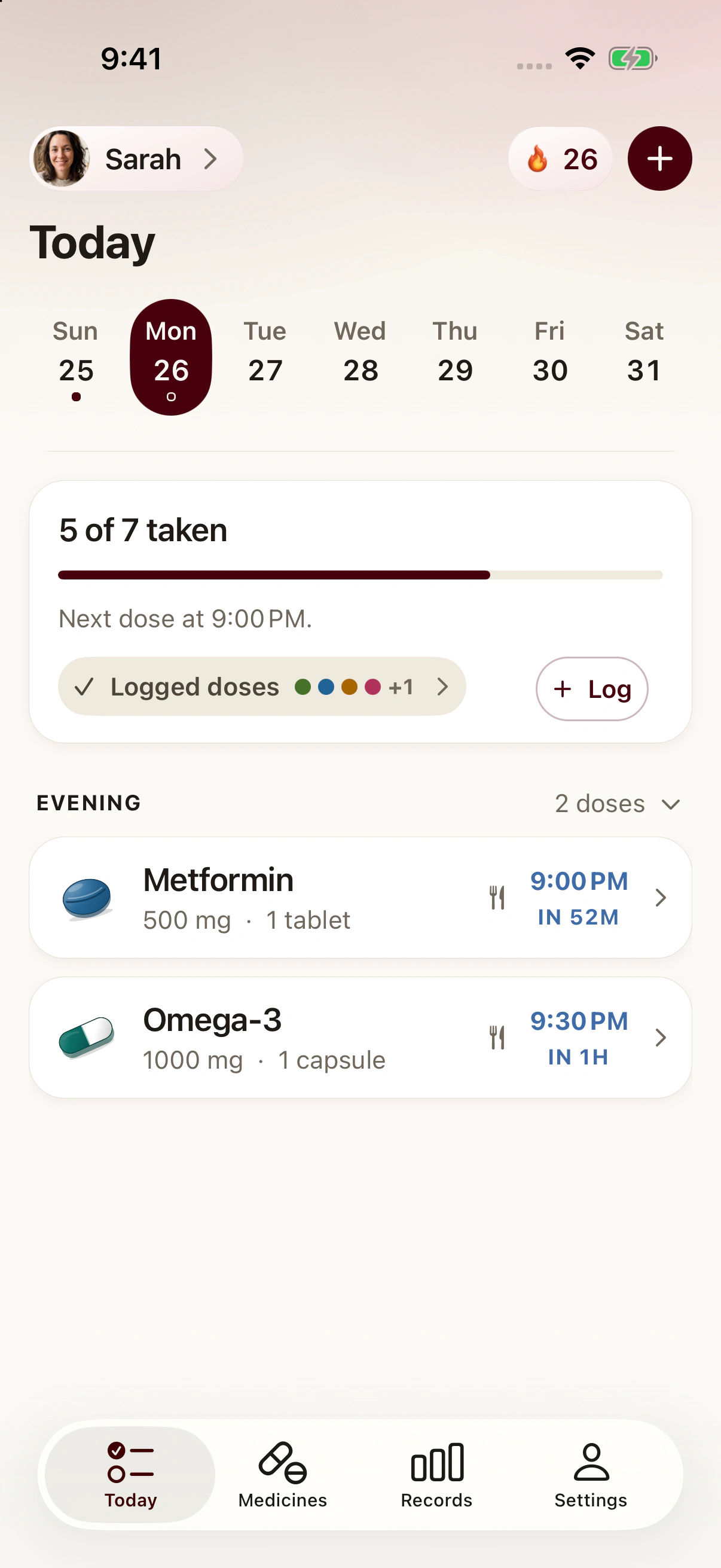
Write the record when you take the dose, then change the next reminder to match the plan. Pillbo can hold those reminders and a log of taken, skipped, or missed, offline on the flight.
Set reminder times to match your written plan. If you are unsure whether a dose was taken, ask a pharmacist before taking more.
If the reminders are in the iPhone Health app, read the schedule prompt when the time zone changes. The steps are in medication reminders on iPhone.
On the day, follow the written plan
Keep a paper copy of the plan with your travel documents, or save a copy you can open offline.
- Before boarding, write the clock time of the last dose you actually took, and name the time zone.
- Set one reminder from the plan: a number of hours after that dose, or a local time your prescriber named.
- Record each dose after you take it.
- If the plan moves you to local time on a named morning, wait for that morning.
- Tell the people you are travelling with about your medical needs. If you carry an emergency medicine, show them what to do with it.
If a dose is missed, or you cannot tell, ask a pharmacist or doctor before taking extra. In Australia, use the numbers on the missed dose guide.
Overseas, use the local emergency number from that country's travel advice.
When you fly home
The flight home is a second time-zone change. Ask, before the outbound flight, how insulin and the contraceptive pill should work on the way back.
Count what is left when you land. A PBS supply cannot be sent to you overseas.
If you ran short, see your usual pharmacist at home. Keep the letter in hand luggage on the way back.
Once you are home, what to do if you have run out of medicine covers a local prescription and a pharmacist supply.
Common questions
How do I take tablets when travelling overseas across time zones?
Ask before you leave whether to stay on Australian time or move to local time. Until then, time the next dose from the last one you took, and write it down.
Can I take PBS medicines out of Australia?
Yes, for your own use or for someone travelling with you. Taking or sending them for anyone else is illegal. Check the amount on 1800 500 147, and check the medicine is allowed where you land.
Should I switch my medicine times to local time as soon as I land?
Only if your doctor or pharmacist told you to. A short trip can stay on home time. A longer trip often needs a written changeover.
What if I cannot remember whether I took a dose on the plane?
Do not take another dose to be safe. Check the pack and the record you made at the time, then ask a pharmacist or doctor.
Sources
- Travel health advice, healthdirect
- Jet lag, healthdirect
- Traveling Abroad with Medicine, CDC
- Travelling with medicines in 2018, Australian Prescriber
- Leaving Australia, Therapeutic Goods Administration
- Taking medicine and medical devices overseas, Smartraveller
- How to manage your PBS medicine overseas, Services Australia
- Running out of PBS medicines when overseas, Services Australia