How to take medicine when you work night shifts
Ask which doses stay on the clock, which need a steady gap, and which can move with when you wake, eat or sleep. Do not take an extra dose to catch up.
Sort each medicine before the roster changes
Night shift, and a rotating roster, move when you wake, eat and sleep. A label that says morning, with food, or bedtime does not name that roster.
Where it is safe, a dose can fit the routine you actually keep. Food can change how some medicines are absorbed, and a medicine for a long-term condition is often kept at the same point relative to meals.
Ask a pharmacist or prescriber about each medicine before you move a time. Take the packs and the roster with you.
Ask before you change the time for any of these:
- A medicine for seizures.
- A medicine that stops blood clots.
- A thyroid medicine.
- A diabetes medicine.
- Any medicine you were told not to delay.
- A medicine that makes you sleepy, or one that keeps you awake.
| What the label says | What to ask |
|---|---|
| Morning | Does this mean a clock time, or when I wake? |
| With a meal, or on an empty stomach | Can this follow the meal I actually eat on this shift? |
| Bedtime | Does this mean when I sleep, even if that is morning? |
| Twice a day, or every so many hours | Does this need a steady gap, including on a changeover? |
Some medicines need that steady gap, and others are tied to a meal or to sleep. The leaflet in the pack explains those words for this medicine.
What with food and an empty stomach mean is in take with food or on an empty stomach.
A medication schedule for night shift
Keep a similar sleep pattern for each kind of shift, and plan the days off as their own pattern. The body clock can take about 10 days to adjust to night work, and days off often slide back towards a daytime routine.
The times below are an example of anchors. They are not dose times, and they are not a schedule to copy onto a pack.
| Example | Wake | Main meal | Before sleep |
|---|---|---|---|
| Day shift | 6:30 am | 7 pm | 10:30 pm |
| Night shift | 4 pm | Midnight | 8 am |
| First day off | A short sleep after the shift, then up | Ask which meal counts | An earlier night |
An afternoon shift needs the same three times: when you wake, the main meal, and sleep. Use a time only for a medicine your pharmacist has tied to that anchor.
On this example, a dose tied to waking would move from 6:30 am to 4 pm, and a dose tied to sleep would move from 10:30 pm to 8 am. A dose kept on a gap stays that many hours after the last one, on any shift.
A flight moves the clock in a similar way. Until there is a written plan, taking medicines across time zones starts from the last dose you took.
Plan the changeover day
Until a pharmacist has answered for that medicine, leave the next dose on the gap since the last one you took. Do not invent a clock time for the new shift.
- Write the week you are entering, including days off, with wake, main meal and sleep for each day.
- Note the clock time of the last dose you actually took.
- Ask which medicines stay on a gap from that dose, and which move on a named day.
- Change the reminders on that day, not in the middle of the shift before.
- Before the first dose of the new pattern, check the log or today's compartment in the pill organiser.
Do not run two schedules at once for the same medicine. A weekday printed on a pill box can be the wrong day after a changeover.
If a dose is late, or you are not sure
Do not take an extra dose to catch up. Open the missed-dose section of the leaflet, and follow it for this medicine only.
If someone is not breathing or will not wake, call 000. If you have already taken an extra dose, call the Poisons Information Centre on 13 11 26.
- Stop, and do not take anything else while you are unsure.
- Read the missed-dose section of that medicine's leaflet.
- Check the log and the chart, and check today's compartment only if you filled it.
- If you still cannot tell, ask a pharmacist or doctor before another dose.
Who to call, and what to do if the dose was already taken twice, is in what to do if you miss a dose.
Keep one record across the roster
After a changeover, one list shows whether the dose was already taken. Include prescriptions, pharmacy medicines and supplements.
- The name and the strength.
- The anchor you were given: a clock time, a gap, when you wake, a meal, or sleep.
- A second time for night-shift weeks, only if it was approved.
- The number to call if the roster changes again.
- Set the reminder to that plan.
- Mark the dose after you take it, not when the alarm rings.
- After a changeover, read the record before you take anything.
- If the record is blank, ask before you take another dose.
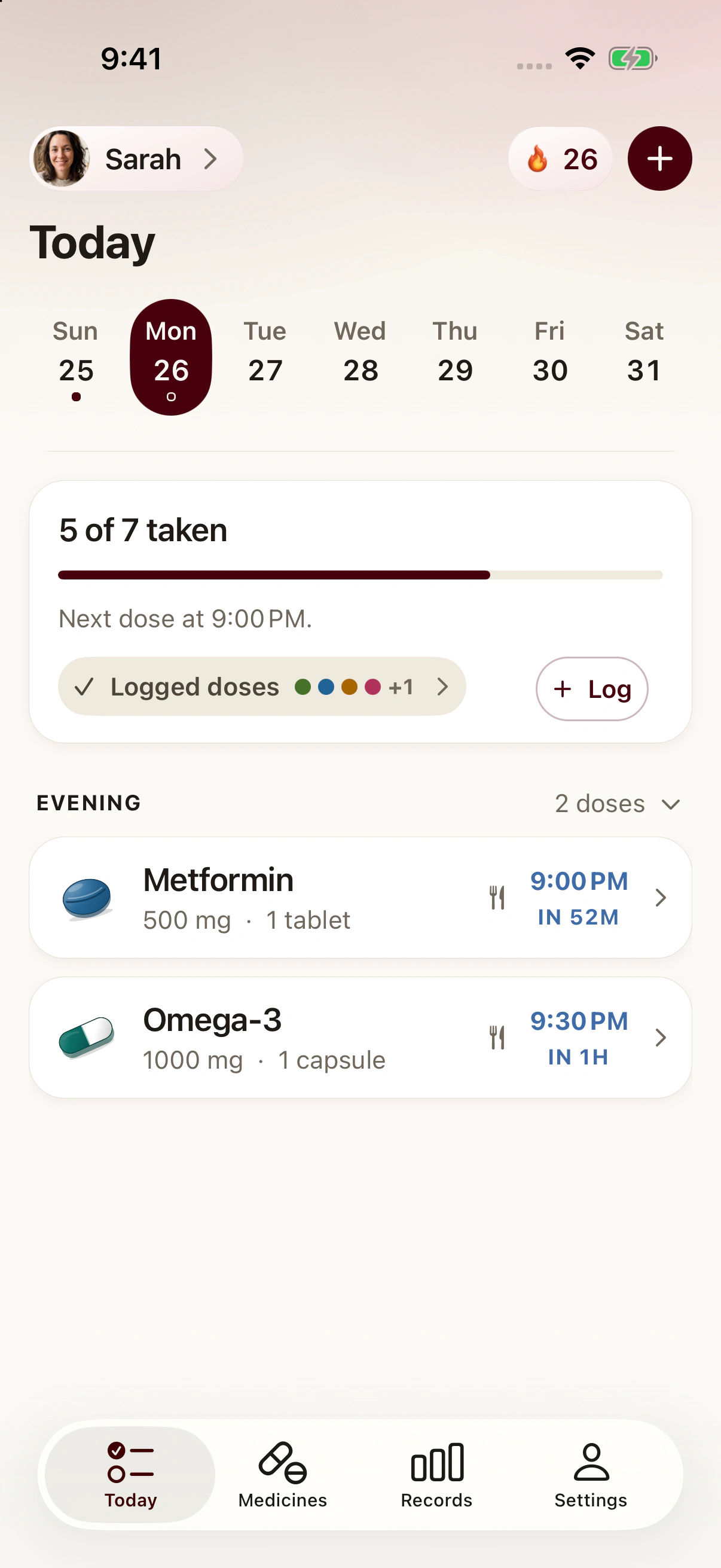
Pillbo can keep a separate schedule for each medicine, and a log of doses you mark taken, skipped or missed. After a changeover, that log is the place to look before you take the dose again.
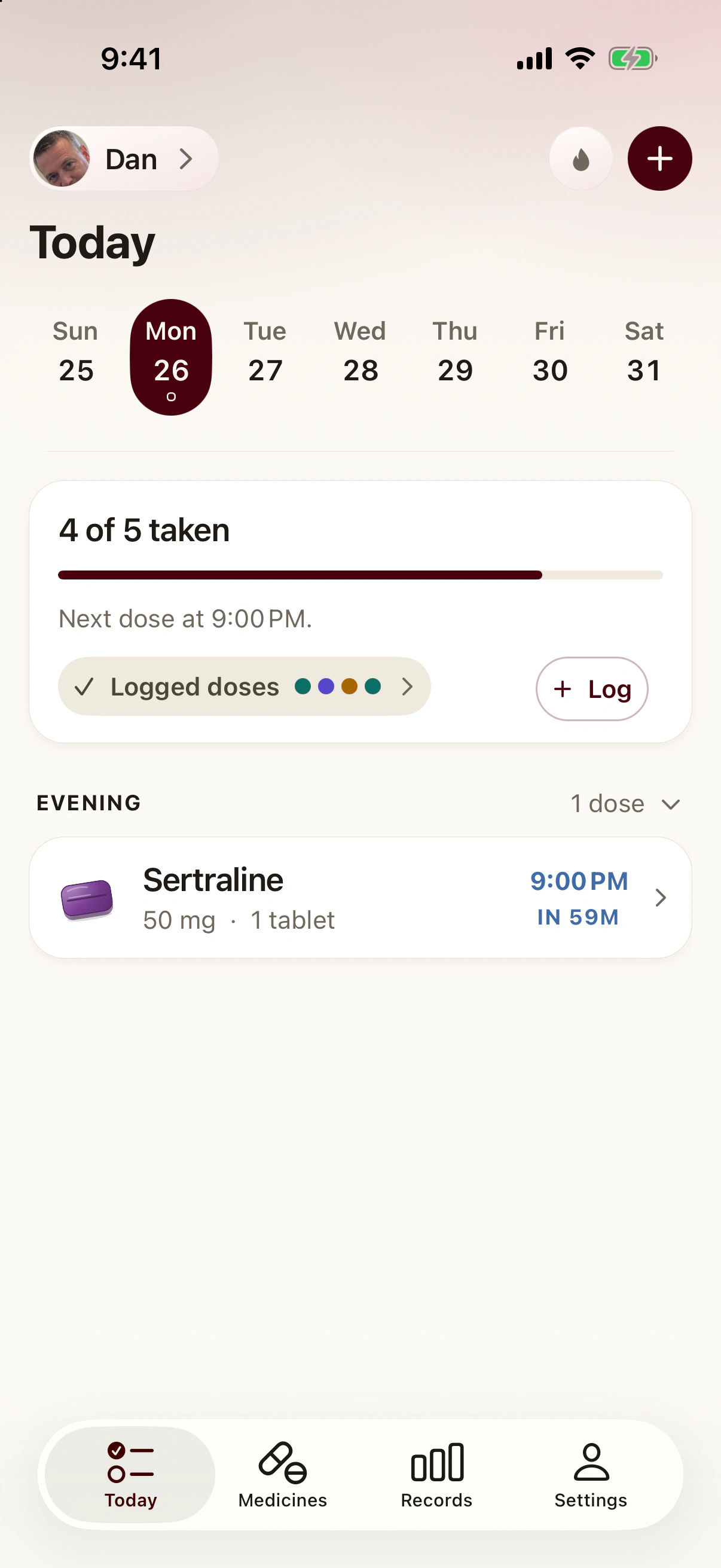
If a dose runs late, its late-dose alarm can ring even on Silent, on iPhone and Android. The log cannot tell you whether that late dose should still be taken.
Before the next block of shifts
- The packs, and the leaflet for each one.
- The written plan for night weeks and for days off.
- The clock time of the last dose before the change.
- One record you will check before each dose.
- Your pharmacist's number, for a dose you are not sure about.
Common questions
When should I take morning medication on night shift?
Ask whether morning means a clock time or when you wake. Do not move that dose until a pharmacist or prescriber says it can.
Can I take a bedtime medicine in the morning after a night shift?
Only if bedtime for that medicine means the sleep you are about to take. A medicine that makes you sleepy and one that keeps you awake are different questions.
What if I cannot remember a dose after changing shifts?
Do not take another to be safe. Check your log or pill organiser, then ask a pharmacist or doctor.
Should I double a dose if night shift made me miss one?
Not as a general rule. Follow that medicine's leaflet, or ask a pharmacist before you take extra.
Sources
- When should I take my medicines?, Australian Prescriber
- I've missed a dose; what should I do?, Australian Prescriber
- Healthy Sleep Practices for Shift Workers, Sleep Health Foundation
- Shiftwork, Better Health Channel
- How to read Consumer Medicine Information (CMI), healthdirect
- Accidental overdose of medicine, healthdirect