Can you take paracetamol and ibuprofen together?
Adults can take paracetamol and ibuprofen together if needed, after trying one on its own, as long as you stay within each pack. For a child, start with one medicine and write down every dose.
Can you take paracetamol and ibuprofen together?
Adults can take paracetamol and ibuprofen together if one medicine is not enough. Try one on its own first, use the lowest amount that works, and stop when the pain has gone.
Taking both does not raise the maximum for either medicine. Each pack still sets its own amount, its own gap, and its own limit for the day.
| Situation | What to do |
|---|---|
| One medicine is enough | Take that one, and follow its pack |
| An adult still needs relief | The other can be taken as well, within its own limit |
| The pack already contains both | Do not add a separate paracetamol or ibuprofen dose |
| A child | Start with one medicine. The children section below sets out the rest |
| You are unsure | Ask a pharmacist before the next dose |
Alternating paracetamol and ibuprofen
Alternating means one medicine, then the other later. Adults can also take both at the same time.
Keep the gap on each pack either way. A dose of ibuprofen does not reset the clock on paracetamol.
- Read the gap on each pack before you take anything.
- Write the name and the time as soon as you take it.
- Take the next dose of that same medicine only when its own gap has passed.
- Count every product with that ingredient toward the day's maximum.
- Stop when the pain has gone, or see a doctor if it has not settled.
Daily limits
Follow the maximum on the pack in your hand. Strengths differ, and an adult who weighs under 50 kg may need less paracetamol, so ask a pharmacist if that applies to you.
| Who | Stay within |
|---|---|
| Paracetamol, 12 years and over | No more than 1 gram every 4 to 6 hours, and 4 grams in a day. Leave at least 4 hours between doses |
| Paracetamol, 1 month to 12 years | The age and weight row on that pack. Doses can be 4 to 6 hours apart, and no more than 4 doses in 24 hours |
| Ibuprofen, adults | The amount, the gap, and the daily maximum printed on that pack |
| Ibuprofen, a child | The age and weight row on that pack, when the label allows it. Doses can be 6 to 8 hours apart, and no more than 3 times in 24 hours |
Do not give paracetamol to a baby under 1 month. Do not give ibuprofen to a baby under 3 months, and check the age on that product.
If ibuprofen upsets your stomach, take it with food, and give a child's dose after a feed. What "with food" means on a label is in take with food or on an empty stomach.
Combination products and cold-and-flu tablets
Some tablets already contain paracetamol and ibuprofen, including Nuromol and Maxigesic. One of those tablets is a dose of both.
Do not add another product that contains paracetamol or ibuprofen. Do not add another pain medicine unless a doctor has advised it.
Cold and flu tablets often contain paracetamol. Check the active ingredients before you take them with anything else, and ask a pharmacist if you are combining products.
| Active ingredient on the pack | Count it as |
|---|---|
| Paracetamol | A paracetamol dose |
| Ibuprofen | An ibuprofen dose |
| Paracetamol + ibuprofen | A dose of both |
| A cold, flu, or sinus product | Read the ingredients, then count whatever is listed |
If you have already taken two products that share an ingredient, see what to do if you accidentally took your medicine twice.
Children
The amount depends on your child's age and weight, and on the strength of that bottle. Use the oral syringe or measuring cup from the pack, or ask a pharmacist for one.
Start with either paracetamol or ibuprofen on its own. If that is not enough, you can give both at the same time, or alternate them, and stay inside each medicine's limit for the day.
Some advice from outside Australia does not recommend giving both at the same time to a child. If you are unsure, ask a pharmacist before the second medicine.
- Match the weight band and the strength on this bottle.
- Measure with the device from the pack, then read the number again.
- Write the name, the amount, and the time before you leave the room.
- Do not give another dose of the same medicine until its gap has passed.
Do not give ibuprofen to a child with asthma, a bleeding disorder, or chickenpox. Measuring and a shared record are in how to give medicine to a child safely.
Who should ask first
Ibuprofen is not suitable for everyone. Ask a doctor or pharmacist before you take it if any of these apply.
| Check first | What to do |
|---|---|
| Stomach ulcer, or gut bleeding, now or in the past | Do not take ibuprofen. Ask about another option |
| Kidney, heart, or liver problems | Ask first. Ibuprofen can make these worse |
| Asthma | Ask first. Do not give ibuprofen to a child with asthma |
| Pregnancy | Ibuprofen is generally not recommended. Ask a doctor or midwife |
| Other medicines | Ask first. This includes other pain relievers, steroids, some blood pressure medicines, and blood thinners such as aspirin |
| Chickenpox | Do not take ibuprofen or aspirin |
| Age over 65 | Ask first. The chance of side effects is higher |
Do not take ibuprofen with aspirin or another anti-inflammatory pain medicine at the same time. That raises the chance of side effects.
Paracetamol is often used in pregnancy, at the lowest amount that works and for a short time. Ask before you take it, including if you have a liver or kidney condition or you are dependent on alcohol.
Keep a note of each dose
The note is how you see when the next dose of that medicine is allowed. It also stops a second person repeating a dose.
- Write the medicine and the time when you take it.
- Include combination tablets and cold-and-flu doses on the same note.
- Check the note before the next dose of the same medicine.
- If a doctor has set regular times, set a reminder for those times and mark the dose after you take it.
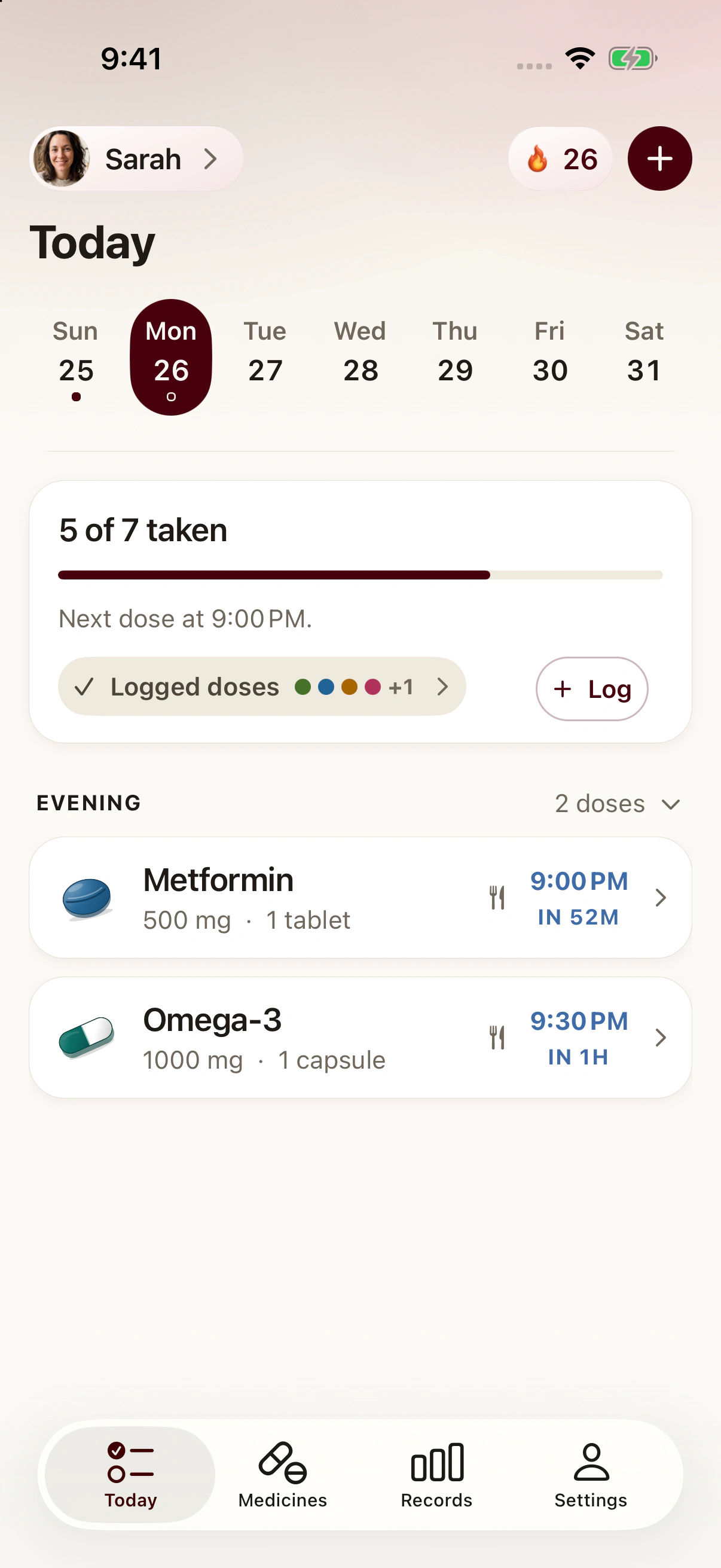
A paper note is enough when everyone uses it. Pillbo can keep a log of the time you mark each dose, so you can see when the next one of that medicine is allowed, and it can remind you when a doctor has advised a regular schedule.
When to get help
See a doctor if the pain or fever is not easing, or if you notice side effects.
| How long | What to do |
|---|---|
| A child on paracetamol | Do not continue past 48 hours unless a doctor says so |
| A child on ibuprofen | See a doctor if they still need it after 48 hours |
| An adult on paracetamol | Do not take it for more than 3 days unless a doctor tells you to |
If you may have taken too much, call 000 and ask for an ambulance, even if you feel well. You can also call the Poisons Information Centre on 13 11 26, and do not wait for symptoms, because too much paracetamol can damage the liver first.
Seek urgent care for severe stomach pain, blood in the vomit, black stools, swollen ankles, or signs of an allergic reaction. Call 000 if someone has trouble breathing.
Outside Australia, use the local emergency number and the local poisons service.
Common questions
Can you take paracetamol and ibuprofen together?
Adults can, if one is not enough. Stay within each pack, and ask first if you are pregnant or have stomach, kidney, heart, liver, or asthma problems.
Is alternating paracetamol and ibuprofen different from taking them together?
You can do either. Alternating still means each medicine keeps its own gap, and you do not take the same one again early.
Can I take Nuromol or Maxigesic and then more paracetamol or ibuprofen?
Only if a doctor has told you to. Those tablets already contain both, so another dose of either ingredient is extra.
Can a child have paracetamol and ibuprofen on the same day?
Start with one. If that is not enough, both at once or alternating is an option, within each day's limit, and ask a pharmacist if you are unsure.
Sources
- Ibuprofen, healthdirect
- Paracetamol, healthdirect
- Medicines for babies and children, healthdirect
- Paracetamol + ibuprofen, healthdirect
- Medicines for colds, flu and COVID-19, healthdirect
- Accidental overdose of medicine, healthdirect
- Ibuprofen uses and side effects, NHS inform
- Paracetamol for adults, NHS
- Nuromol Dual Action Pain Relief, Australian Commission on Safety and Quality in Health Care
- MAXIGESIC, Australian Commission on Safety and Quality in Health Care