How to prepare for thunderstorm asthma
Thunderstorm asthma is asthma set off by grass pollen and a certain kind of thunderstorm, including in people who have never had asthma. In Victoria's grass pollen season, check the risk forecast, take prescribed preventer treatment as directed, and know asthma first aid.
What thunderstorm asthma is
Thunderstorm asthma is asthma triggered by a lot of grass pollen in the air and a certain kind of thunderstorm. In Victoria the grass pollen season runs from 1 October to 31 December.
Grass pollen grains can burst and release tiny particles. Those particles gather in the wind gusts just before the rain, and they are small enough to breathe deep into the lungs.
Symptoms can come on quickly. They include shortness of breath, a tight chest, wheezing, and a cough that keeps going.
It can affect someone who has never had asthma. These epidemic events are uncommon, and they can be life-threatening.
Who is at risk
Prepare if any row fits you. The risk is higher again when asthma and hay fever occur together, especially if the asthma is poorly controlled.
| You | What to do |
|---|---|
| Current asthma | See your GP, and review your written asthma action plan |
| Asthma in the past | Ask your GP how to protect yourself this season |
| Wheeze, breathlessness, a tight chest, or a cough that persists, with no diagnosis | See your GP. Do not ignore those symptoms |
| Springtime hay fever | Ask a GP or pharmacist for a hay fever plan |
The highest risk of a life-threatening flare-up is in people with asthma who are allergic to ryegrass pollen and are not using an inhaled corticosteroid. A blue reliever on its own is not that treatment.
If symptoms start for the first time in a storm, or your usual asthma medicine does not settle them, see a GP once you are safe. Call 000 first when breathing is severe.
Prepare during grass pollen season
The coloured forecast does not replace daily treatment. Good asthma and hay fever care is what protects you on green days as well as red ones.
- Book a GP visit to check control, and to write or update a written asthma action plan that includes thunderstorm advice.
- Take any prescribed inhaled corticosteroid treatment every day it is prescribed, including days you feel well. The Australian Asthma Handbook describes that treatment as protective.
- If you are not on a preventer all year and you will be around ryegrass pollen, ask your GP about using one from September to December.
- Check the reliever is in date, the dose counter has enough left for the rest of the season, and the puffer is with you.
- For springtime hay fever, ask a GP or pharmacist before you start treatment. A pharmacy can supply a reliever puffer without a prescription.
Keep the preventer at the time you were given. How to remember to take your medicine is that daily routine.
Hay fever and thunderstorm asthma
When a doctor or pharmacist recommends a corticosteroid nasal spray for hay fever, use it regularly, not only on bad days. For spring, start it at the beginning of September and continue to the end of December, because it works best when the course begins before the pollen season.
If that window has already started, ask whether to begin now, then use the spray on the days they set. There is not enough clinical trial evidence that nasal steroid sprays protect against thunderstorm asthma.
Check the thunderstorm asthma forecast
From 1 October to 31 December, Victoria publishes an epidemic thunderstorm asthma risk forecast for today, tomorrow and the day after. The map is on the VicEmergency app and website, and the forecast page explains the colours.
| Colour | Risk | Meaning |
|---|---|---|
| Green | Low | The mix needed for an epidemic event is not expected, so an event is unlikely |
| Orange | Moderate | High grass pollen, or a severe thunderstorm with strong winds, may be present, so the chance is moderate |
| Red | High | High grass pollen and severe thunderstorms with strong winds are both likely |
A higher colour means a higher chance, and an event can still fail to arrive. A lower colour means an event is less likely, and one can still happen.
This forecast is separate from the ordinary spring rise in hay fever and asthma.
Today's colour is updated once, at about 12.30 pm. Later warnings, including on a high-risk day, are posted on VicEmergency.
A grass pollen forecast only estimates how much pollen is in the air. Melbourne Pollen publishes Victoria's counts, and that is a different forecast from this one.
Outside Victoria, check the Bureau of Meteorology and a local pollen count, then use the indoor steps below. healthdirect lists pollen tools for other places.
To hear when a high risk is forecast where you are:
- Open VicEmergency and create a watch zone.
- Search your address or suburb, and set the radius.
- Name the zone, and leave advice warnings on.
On a forecast day
Go indoors before the wind gusts that come ahead of the rain. Do this for any thunderstorm in the grass pollen season, including when you have not checked the colour yet.
- Go inside a building, or stay in the car.
- Close the windows and doors.
- Turn off cooling that brings outside air in, such as an evaporative air conditioner.
- In the car, keep the windows up and set the air to recirculate.
- Keep your reliever with you.
Being indoors may not block every particle. Have the reliever and the first-aid steps ready as well.
A face mask does not stop these particles.
Keep the reliever out of a parked car. How to store medicines covers heat, and ran out of medication is what to do if the counter is already empty.
Asthma first aid
Follow the person's written asthma action plan if they have one. Start first aid before the symptoms become severe.
These four steps are for a person aged 12 or over, using a blue/grey puffer such as Asmol, Ventolin or Zempreon, with a spacer. For a child under 12, or for Airomir, Bricanyl or a combination inhaler, use the matching chart on the asthma first aid page rather than these puff counts.
- Sit the person comfortably upright. Stay calm and reassure them.
- Give 4 separate puffs. Shake the puffer, put it upright into the spacer, press once for one puff, and have them take 4 breaths in and out of the spacer. Repeat until 4 puffs are taken.
- Wait 4 minutes. Stay with them and watch. Call 000 at any time and say that someone is having an asthma attack.
- After 4 minutes, use the row that matches their breathing.
| After 4 minutes | What to do |
|---|---|
| Breathing normally | If they feel better and are breathing normally, get them to a doctor for a check-up |
| Still cannot breathe normally | Give 4 more puffs. If they still cannot breathe normally within a few minutes, call 000, and keep giving 4 puffs every 4 minutes until the ambulance arrives |
| Worse, or a severe breathing problem | Call 000 now, and keep giving 4 puffs every 4 minutes until the ambulance arrives |
Each later round is 4 separate puffs, with 4 breaths for each puff.
Call 000 and ask for an ambulance if the person is not breathing, is drowsy, looks blue around the lips, is getting worse, is not getting better, or you are not sure what to do. Say that someone is having an asthma attack.
If an attack is underway and no reliever is to hand, call 000. Use their own reliever if you can, or a blue/grey puffer from a first-aid kit, or one you borrow.
If they have a known allergy to a food, an insect sting or a medicine, and breathing trouble starts suddenly, use their adrenaline autoinjector first, even with no rash. Then give the reliever.
If they stay conscious, breathing is the main problem, and you are not sure it is asthma, a blue/grey reliever is unlikely to harm them. Call 000 as well.
With no spacer, the same first-aid page shows a plastic drink bottle or rolled-up paper, and how an adult can use the puffer without one.
Once they are breathing normally, arrange a GP check. For asthma questions call 1800 278 462, and call healthdirect on 1800 022 222 when you are unsure and it is not an emergency.
Keep the daily preventer going
The dose that protects you is the one you take on ordinary days. A reminder only helps if it stays at the time you were prescribed.
- Set a daily reminder for the preventer at that time.
- Mark the dose after you take it, so a missed day shows before the next storm.
- Log each time you use the reliever, and take that record to the GP.
- Note how many doses the counter has left, and arrange a refill before it runs out.
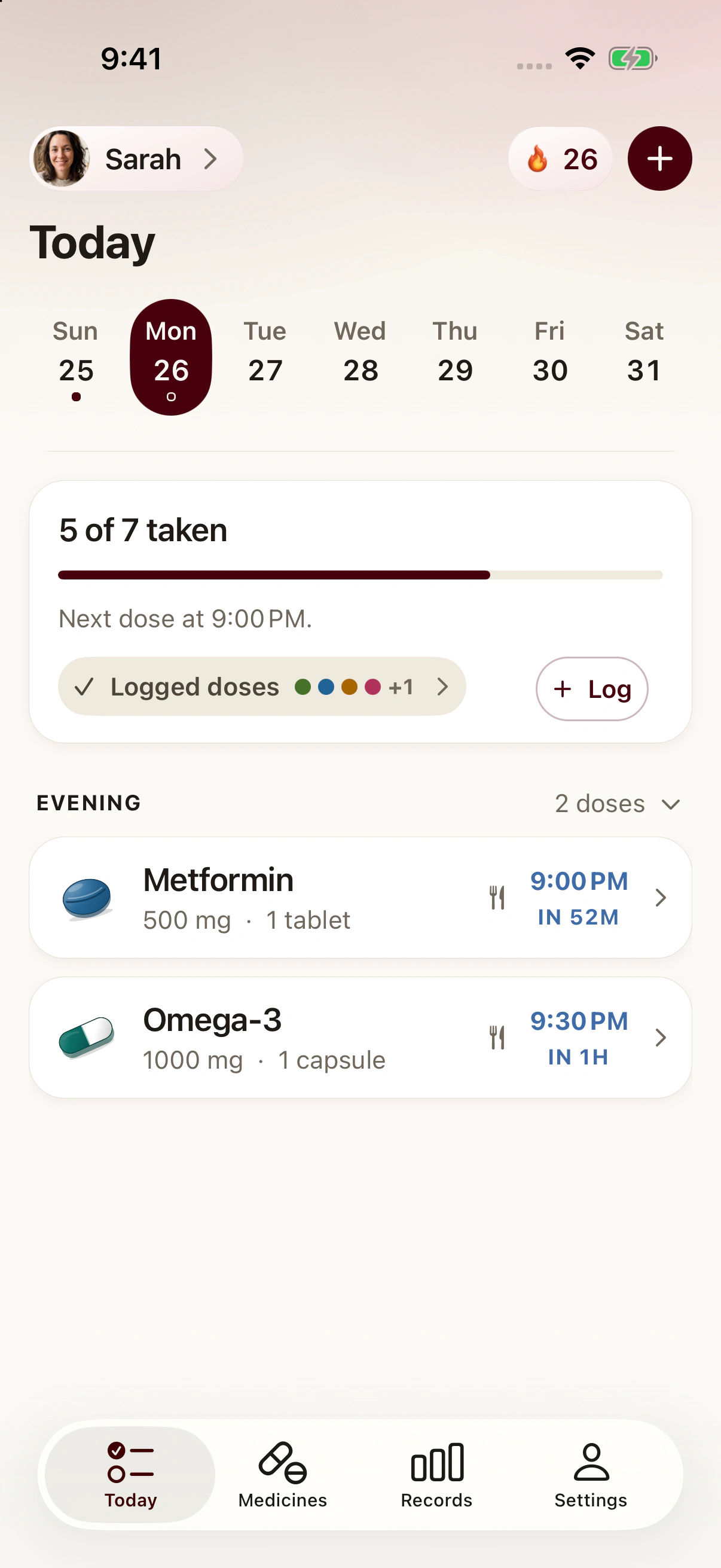
Pillbo can hold that daily reminder, a log of doses you mark, and a flag when a medicine is running low or due to expire. If the preventer dose runs late, its late-dose alarm rings even on Silent, on iPhone and Android.
It will not tell you whether a late dose should still be taken. It does not replace an asthma action plan or these first-aid steps.
Common questions
What is thunderstorm asthma?
Asthma symptoms triggered when grass pollen and a certain kind of thunderstorm put tiny pollen particles into the air you breathe.
Can hay fever lead to thunderstorm asthma?
People with springtime hay fever are at risk, including some who have never been diagnosed with asthma, and the risk is higher if they also have asthma.
Where do I check the thunderstorm asthma forecast?
In Victoria, use the VicEmergency app or website from 1 October to 31 December. Green is low, orange is moderate, and red is high.
Does a hay fever nasal spray prevent thunderstorm asthma?
A corticosteroid nasal spray can help hay fever if a doctor or pharmacist recommends it, but trial evidence that it prevents thunderstorm asthma is lacking.
Sources
- Epidemic thunderstorm asthma risk forecast, Victorian Department of Health
- Thunderstorm asthma, Australian Asthma Handbook
- Thunderstorm asthma, healthdirect
- Thunderstorm asthma, Better Health Channel
- Thunderstorm asthma fact sheet, Better Health Channel
- Asthma first aid, National Asthma Council Australia
- First aid for asthma ages 12 and over, National Asthma Council Australia
- Thunderstorm asthma, Asthma Australia
- Hay fever, Asthma Australia
- Hay fever (allergic rhinitis) and your asthma, National Asthma Council Australia